
FDA 21 CFR Part 11 Compliant Microscope Imaging Software
When microscope images are stored as digital files, they may be subject to regulatory requirements governing electronic records, most notably the FDA's 21 CFR Part 11 in the United States and EU GMP Annex 11 in the European Union. Both are built on the ALCOA+ data integrity principles, and special compliant software is required to manage your images according to these requirements.
Maintaining compliance for your digital images is challenging. Unlike text documents, where it is a simple matter to compare old and new versions to determine how they have been changed, it is usually not possible, when looking at two versions of an image, to determine the processing steps that have led to the changed image. Therefore, specialized software is required to audit every processing step and to keep read-only copies of every predecessor version of each image.
Whether you use a light microscope, SEM or TEM, Quartz PCI-CFR helps you meet this challenge, whether your obligations arise under 21 CFR Part 11, EU Annex 11, or both. PCI-CFR acquires data directly from the instrument with no intervening file save step. Therefore, you are assured that the original, raw data has been captured from the instrument. After data capture, every processing and annotation operation that is carried out on the image is recorded in a secure audit trail. The raw data and each subsequent version of the image are saved in read-only, encrypted files so that you can always retrieve earlier versions of processed images and you can be sure they have not been tampered with. Members of your organization can apply digital signatures to the data. Finally, you can export your data as digitally signed, industry standard PDF files for regulatory submission or sharing with colleagues. For more on how these two regulations compare, and the ALCOA+ data integrity principles behind both, see Understanding FDA 21 CFR Part 11.
Helps You Comply with 21 CFR Part 11
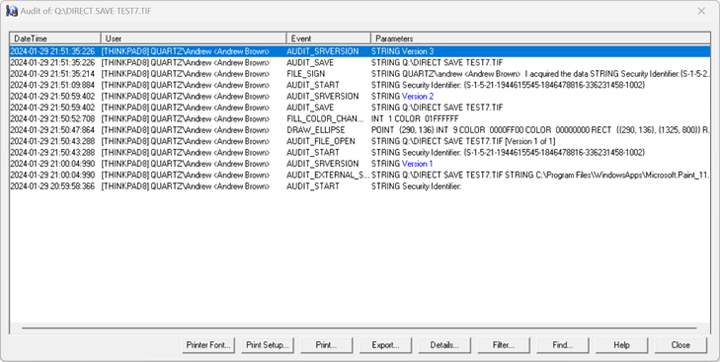
- A 21 CFR Part 11 compliant audit trail is maintained of all operations carried out on images by the user
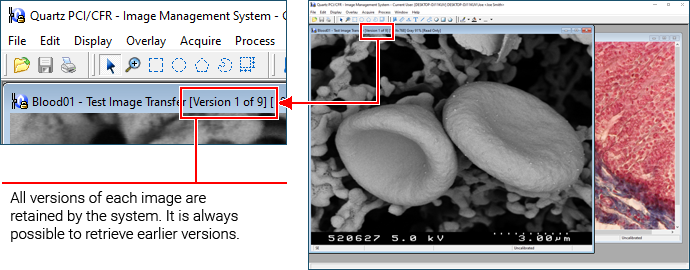
- All versions of image files are retained by the system. If the user saves a new version of an image, it is assigned a version number in sequence and does not overwrite the original data
- Digital signatures can be applied to images
- Data files are encrypted to discourage tampering and are protected using a "digest" to detect tampering
- Access to the system is controlled and different user roles are supported
- Digitally signed PDF files may be exported
ALCOA+ Data Integrity for Microscope Images
Regulators assess electronic records against the ALCOA+ data integrity principles. Both FDA 21 CFR Part 11 and EU GMP Annex 11 are built on them. Quartz PCI-CFR addresses each principle directly for digital microscope images:
Attributable
Every action is recorded against a named, authenticated user. Users log in with a username and password, re-authenticate after periods of inactivity, and re-authenticate again when applying a digital signature. The audit trail records the user name, computer name, date, time, and specific detail of every operation.
Legible
Images and their audit trails remain readable throughout the retention period. Any version can be opened and reviewed at any time, and records can be exported as digitally signed, industry-standard PDF files for inspection without requiring access to the software.
Contemporaneous
Data is captured directly from the instrument with no intervening file save step, and each operation is time-stamped in the audit trail at the moment it occurs.
Original
The raw data as received from the instrument is saved before any operator changes. No version is ever overwritten. Every subsequent version is retained in sequence, so the original data is always recoverable.
Accurate
All data files are encrypted, and each file carries a cryptographic digest that makes tampering detectable. If PCI-CFR detects a problem with a file when it is opened, it denies access and flags the issue.
The "+" additions are addressed by the same controls:
Complete
Processing and annotation operations are captured in the audit trail whether or not the image is subsequently saved. A separate Workstation Log records data acquisition, file access, and security events even in sessions where no image was saved.
Consistent
Every entry is recorded in sequence with its own time stamp, so the order of events is preserved and reconstructable.
Enduring
Records are retained in encrypted, read-only files rather than in transient working storage.
Available
Any version of any record can be retrieved and reviewed on demand, and exported as a signed PDF for auditors or regulatory submission.
21 CFR Part 11 Image Capture
Images are captured directly from light and electron microscopes. Packages are available for direct image transfer from PC-based SEMs or slow scan capture from other SEMs. For light microscopes, images can be acquired from video or digital still cameras.
Retention of Original Data
Original data transferred from the instrument is saved by the system prior to any changes by the operator. Thereafter, each version of the data is also stored as changes are made. It is always possible to retrieve predecessor versions of the data.
Authority Checks
Users of Quartz PCI-CFR are required to authenticate using their user name and password before they can use the software. System administrators can assign rights (such as the ability to acquire data or the ability to digitally sign records) on a user-by-user basis or to groups of users. Users are required to re-authenticate after periods of inactivity and upon applying digital signatures to records.
21 CFR Part 11 Audit Trail
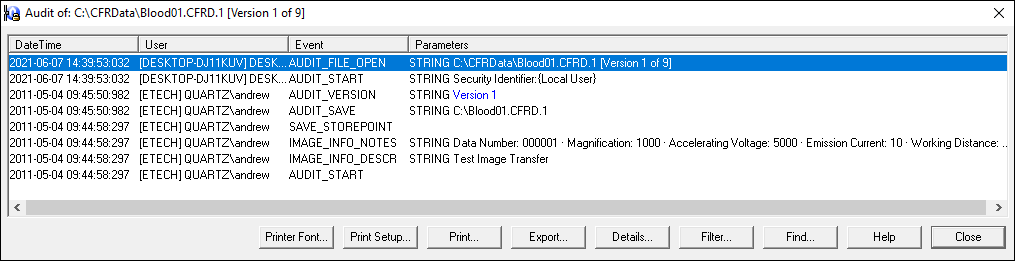
Every user action is retained in an audit trail which includes the date and time, user name, computer name and specific details of the action.
Data Encryption
All data is encrypted to make unauthorized changes virtually impossible while, at the same time, digital signature technology makes tampering easily detectable.
21 CFR Part 11 Electronic Signatures
Images stored as electronic records can be digitally signed by authorized users. Signature information includes the name of the signer, the date and time of signature execution and the meaning of the signature, such as review, approval, responsibility or authorship. Applying a digital signature requires entry of two distinct identification components (user name and password). These signatures are embedded within their respective electronic records and cannot be excised from them.
Data Export
Data can be exported as digitally signed PDF files and in other, standard image formats. These files can be readily copied, displayed or printed for inspection or review.
Secure Repository
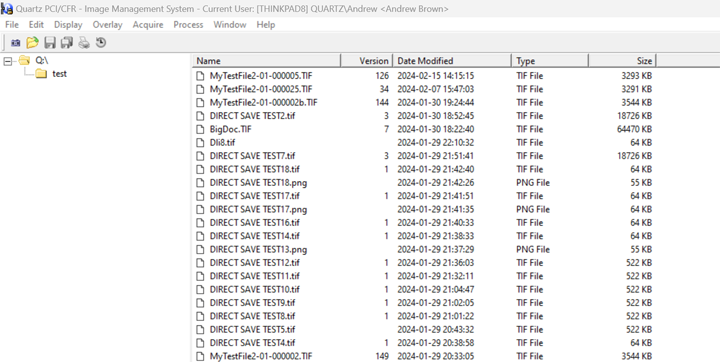
This option for your Quartz PCI-CFR Lab license provides a virtual disk drive (Q:) accessible through your PC that can securely store any type of file. Files stored in this secure repository will have CFR Part 11 support such as an audit trail and version management. You can control what file types are allowed to be stored in the secure repository. The audit trail will include who saved the file, what PC was it saved from, what application was used to save the file. when the file was saved and the version number of the file.
Quartz Virtual Printer Driver
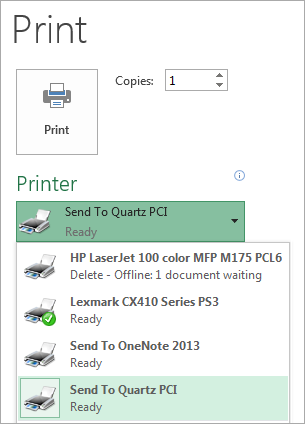
With any Quartz PCI-CFR Lab license, you can add our Virtual Printer Driver or you can purchase the Virtual Printer Driver as a stand-alone license, depending on your application. When added on to your PCI-CFR Lab license, it will allow you to "print" any type of file from any Windows based software application that resides on the same computer as PCI-CFR Lab. When the application that you want to "print" from is not on the same PC as your PCI-CFR Lab license (such as an EDX support PC), you would purchase the Virtual Printer Driver as a stand-alone license.
In both situations, when you, in the other software application, use the Print function and select the Send To Quartz PCI printer, this will create an image file in PCI-CFR that will be saved as version 1 and from that point forward will be within the CFR-compliant control of PCI-CFR.
Electron Microscopes
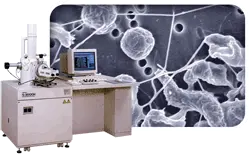
PCI-CFR Lab can import images from most PC-based SEMs.
PCI-CFR reads the magnification calibration information from files acquired from instruments from most manufacturers, including:
- Delong
- FEI
- Gatan
- Hitachi
- JEOL
- Phenom
- Tescan
- Thermo Fisher
- Zeiss
You can make measurements right away with no calibration step required.
Light Microscopes
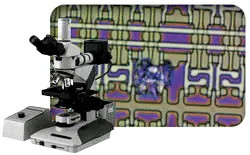
PCI-CFR permits straightforward image capture from light microscopes with support for:
- Video Cameras
- Digital Cameras
Calibration information is read automatically from images acquired from Keyence microscopes.
Quartz PCI-CFR works with any make and model of light microscope, including those from the following manufacturers.
- Olympus
- Leica
- Keyence
- Nikon
- Motic
Other Imaging Instruments
Digital Still Cameras/Scanners
PCI-CFR supports the popular TWAIN standard. Images can be acquired from most scanners and digital still cameras.
Direct to Digital Instruments
Software is available to facilitate the transfer of images from instruments, both Windows®-based and non-Windows®-based, that produce digital images directly, such as:
- AFMs
- PC-based SEMs
- FIBs
- Acoustic microscopes
- and more
Workstation PCs
Quartz PCI-CFR Office is used for offline viewing, processing, measurement and analysis of images acquired with Quartz PCI-CFR Lab Packages. Quartz PCI-CFR Office includes all of the functionality of the Lab version, with the exception of image acquisition.
Features of PCI Office include:
- Viewing
- Measurement
- Annotation
- Processing
while maintaining the 21 CFR Part 11 compliant audit trail.
Frequently Asked Questions (FAQ)
What is Quartz PCI-CFR?
Quartz PCI-CFR is a specialized version of Quartz PCI microscopy software designed for laboratories that need to manage digital images in compliance with FDA 21 CFR Part 11 regulations governing electronic records and electronic signatures. It acquires, stores, processes, and annotates images from light and electron microscopes while maintaining the complete audit trail, version control, encryption, and digital signature capabilities required by regulated laboratory environments.
The current version is PCI-CFR Version 6, which added Secure Repository support, an expanded workstation log, Windows 11 compatibility, and enhanced digital signature controls.
What is FDA 21 CFR Part 11, and why does it matter for microscopy?
FDA 21 CFR Part 11 is a regulation that establishes requirements for electronic records and electronic signatures used in FDA-regulated industries, including pharmaceutical, biotechnology, and medical device manufacturing. It requires that electronic records be trustworthy, reliable, and equivalent to paper records, meaning data must be protected against unauthorized alteration, changes must be traceable, and signatures must be attributable to specific individuals.
Microscopy images present a particular challenge under 21 CFR Part 11 because, unlike text documents, it is typically not possible to compare two versions of a processed image and determine what processing steps were applied. Specialized software is therefore required to audit every processing operation and retain every predecessor version of each image in a protected, unalterable state.
How does PCI-CFR differ from standard Quartz PCI?
PCI-CFR and Quartz PCI are separate products serving different purposes. PCI-CFR is a purpose-built product focused on 21 CFR Part 11 compliant image capture and storage, with a more targeted feature set oriented around data integrity controls rather than broad analytical capability. It also adds the following additional controls specifically for 21 CFR Part 11 compliance:
- Mandatory user authentication on every login, with re-authentication after 15 minutes of inactivity
- Complete audit trail recording every user action on every image, including date, time, username, computer name, and action detail
- Full version retention: every saved version of an image is stored; no version is ever overwritten or deleted
- Data encryption protecting stored image files against unauthorized modification
- Tamper detection via cryptographic digests: any attempt to alter a file outside of PCI-CFR is detectable
- Digital signatures enabling authorized users to sign images as electronic records
- Digitally signed PDF export: exported PDFs carry a cryptographic signature certifying they are unaltered representations of the stored data
- User roles and permissions controlling which users can acquire, view, modify, and sign data
- Workstation log tracking all system access and file access events, even when no images are saved
For batch processing runs, measurement data across all processed images is aggregated into a single CSV output file, providing a consolidated dataset ready for downstream analysis.
What is the PCI-CFR audit trail record?
The audit trail in PCI-CFR records every operation carried out on an image within the software, including the date and time, the username, the computer name, and specific details of the action. This includes acquisition, all processing and annotation steps, saves, file opens, and digital signature events.
Authentication events: logins, logouts, session locks and unlocks, and failed login attempts are additionally recorded in the Windows Application Event Log, providing a system-level record of software use independent of whether any images were saved during the session.
A separate Workstation Log captures data acquisition events, file access events, and security-related events, providing a second layer of system activity tracking.
How does PCI-CFR protect against data tampering?
PCI-CFR uses two complementary protection mechanisms:
- Encryption: all data files are encrypted, making unauthorized modification of the underlying files virtually impossible
- Cryptographic digests: each file is protected with a digest that allows the system to detect any tampering that may have occurred, even if the encrypted data was accessed outside of PCI-CFR
If PCI-CFR detects a problem with a file when it is opened, it will deny access and flag the issue.
How does version control work in PCI-CFR?
PCI-CFR never overwrites an existing image file. Every time an image is saved, the system generates a new versioned file pair, incrementing the version number in sequence. Both the original data as received from the instrument and every subsequent processed version are retained in full. Users can open and review any historical version of an image at any time.
This means the original raw data as it came off the instrument is always recoverable, regardless of what processing or annotation has been applied in subsequent sessions.
How do digital signatures work in PCI-CFR?
Authorized users belonging to the PCICFR-Sign Windows group can apply digital signatures to images stored in PCI-CFR. Applying a signature requires entry of two distinct identification components, username and password, as required by 21 CFR Part 11. The signature record includes the name of the signer, the date and time of signing, and the meaning of the signature, such as review, approval, responsibility, or authorship.
Signatures are embedded within the electronic record and cannot be separated from it. Rules can be applied to signatures to control the order in which signatures must be applied and whether a signature may be applied more than once.
A user who is logged in can also request that a different authorized user sign the image without requiring the first user to log out, supporting review workflows where the reviewer and the data originator are different individuals.
Can PCI-CFR export digitally signed PDFs?
Yes. PCI-CFR can export images as digitally signed PDF files. The PDF carries a cryptographic signature applied by PCI-CFR certifying that the file is an unaltered representation of the data stored in the CFR-compliant record at the time of export. The audit trail is included in the export. These PDFs are suitable for regulatory submissions, client deliverables, or sharing with colleagues outside the organization.
The digital signature can be verified in Adobe Acrobat once the Quartz Imaging certificate has been added to the trusted identities list.
What user roles and permissions does PCI-CFR support?
PCI-CFR manages user permissions through Windows Local Group membership. Four standard groups are provided, each granting a different level of access:
- PCICFR-Acquire: can acquire images and save newly acquired images only
- PCICFR-ReadOnly: can open and view images but cannot modify or save them
- PCICFR-ReadWrite: can open, modify, and save images
- PCICFR-Sign: can apply digital signatures to images
Users can belong to more than one group, allowing flexible role configurations. For example, a reviewer could be assigned to both PCICFR-ReadOnly and PCICFR-Sign, permitting them to review and sign images without being able to modify the underlying data.
What instruments and image sources does PCI-CFR support?
PCI-CFR supports image acquisition from any light or electron microscope, using the same acquisition options as Quartz PCI:
- Direct integration with some PC-based SEMs
- TWAIN interface for digital still cameras on light microscopes
- Spider (hot folder): automatically loads images deposited into a designated folder by non-integrated SEMs and light microscopes
- USB slow-scan capture for analog SEMs
- Virtual Printer Driver: captures output from any Windows application with a print function, treating it as a controlled document within PCI-CFR
PCI-CFR reads and retains calibration information from most major digital SEM manufacturers.
What is the Secure Repository in PCI-CFR?
The Secure Repository is an optional add-on for PCI-CFR that extends 21 CFR Part 11 controls to non-image data and to data generated by third-party software. It works by creating a virtual disk drive on the workstation (assigned drive letter Q: by default). Any file saved to this virtual drive, including TIF files, EDS spectra, Excel spreadsheets, or other data files, is automatically subject to version control, encryption, and audit trail tracking.
The Secure Repository is the appropriate choice when:
- You need to save raw data or analysis files from third-party software in a compliant manner
- You want to re-open and continue working with those files in their source application while maintaining version control
- You need to use third-party image analysis tools (such as particle counting software) to analyze images acquired by PCI-CFR
The Secure Repository records who saved or accessed each file and when. Because all versions are retained, it is possible to compare versions and identify changes even when the audit trail cannot capture internal operations of the third-party software.
What is the Virtual Printer Driver in PCI-CFR?
The Virtual Printer Driver installs as a Windows printer on the workstation. Any Windows application with a print function: EDS analysis software, Excel, instrument control software can send its output to PCI-CFR simply by selecting "Send to Quartz PCI" as the printer. The output is received and stored by PCI-CFR as a controlled document, subject to version control and audit trail tracking.
The Virtual Printer Driver is the appropriate choice when you want to capture non-image data in a final, unchangeable report form, or when you want to apply a digital signature to non-image data.
Note: Because 21 CFR Part 11 requires digital signatures to be visible when data is displayed, and PCI-CFR cannot control how third-party software renders data, direct digital signatures are not available for files stored in the Secure Repository. The recommended approach for signing non-image data is to print the data to PCI-CFR via the Virtual Printer Driver and sign the resulting document within PCI-CFR.
Can I use other software to analyze images that are under PCI-CFR control?
Yes, with the Secure Repository option. Images acquired by PCI-CFR and stored in the Secure Repository are saved in industry-standard TIFF format, which can be opened by third-party image analysis software. If the file is re-saved by the external application, PCI-CFR records the event in the audit trail and retains the new version alongside all previous versions.
For labs that use specialized tools such as particle counting or image analysis software alongside PCI-CFR, this workflow maintains a compliant chain of custody without requiring that all processing be performed inside PCI-CFR.
For workflows where the standard operating procedure takes an image into external software and back, Quartz Imaging can assist with documenting the process to support compliance requirements.
What image processing and annotation capabilities does PCI-CFR include?
PCI-CFR includes a full set of image processing and annotation tools comparable to those in Quartz PCI:
- Processing: contrast, brightness, and gamma adjustment; color correction; hue and saturation; local contrast; sharpening and median filtering; image rotation and resize; zooming, panning, false coloring, and slide show
- Measurement: line measurement, angle measurement, with measurement tools operating on the calibrated image
- Annotation: line, freehand, circle/ellipse, square/rectangle, polygon, and text drawing tools, operating on a separate overlay layer; Default Overlay for permanent marking such as company logo or confidential indicator
- General: micron marker function; slide show; dual monitor and widescreen support; output to any Windows-supported printer
All processing and annotation operations are captured in the audit trail regardless of whether the image is subsequently saved.
What Windows versions does PCI-CFR support?
PCI-CFR Version 6 supports 32-bit and 64-bit versions of Microsoft Windows 7, Windows 8, Windows 10, and Windows 11.
Does Quartz Imaging support an IQ/OQ process for PCI-CFR?
Yes, IQ/OQ (Installation Qualification / Operational Qualification) support is available from Quartz Imaging. Qualification is conducted via web meeting, using Teams or GoToMeeting and typically takes approximately two and a half to three hours per instrument workstation. Quartz Imaging can perform the software installation as part of the IQ/OQ session, or customers can install the software themselves using the standard Windows installer and detailed configuration guidance provided by Quartz Imaging.
For sites where the instrument workstation cannot be connected to the internet, Quartz Imaging offers a license to use their IQ/OQ protocol and report template, which can be executed on-site without remote access. The license is per instrument, with no additional cost if the IQ/OQ needs to be repeated on the same instrument.
Requirements for a web-meeting IQ/OQ include a workstation connected to the corporate network, a local administrator login, installed driver software for the instrument (TWAIN driver for light microscope cameras, for example), a sample of known dimensions for SEM systems, and a stage micrometer for light microscope systems.
Can PCI-CFR be installed independently, without Quartz Imaging conducting the IQ/OQ?
Yes. PCI-CFR uses a standard Windows installer and Quartz Imaging provides detailed configuration documentation to support independent installation. IQ/OQ support is available as a separate service if required.
Licensing and Purchasing
How is Quartz PCI-CFR sold?
Quartz PCI-CFR is sold by subscription. As a subscriber, you receive ongoing access to technical support and periodic updates to the latest version.
What is included in a PCI-CFR subscription?
A PCI-CFR subscription includes access to the current version of the software, ongoing technical support, and periodic software updates as they are released.
How do I activate Quartz PCI-CFR after installation?
If the computer has internet access, activation occurs automatically the first time the software is launched. If automatic activation fails, you can activate manually by saving an Activation Request file and uploading it to https://activation.quartzimaging.com, or by emailing the file to activate@quartzimaging.com
Can I install PCI-CFR on a computer without internet access?
Yes. Manual activation is available. You save the Activation Request file to a USB drive, transfer it to an internet-connected computer, upload it to the Quartz Imaging activation portal, then return the License Key file to the offline computer and load it into PCI-CFR.
Technical Support
How do I get support for PCI-CFR after installation?
Quartz Imaging provides technical support to all active subscribers. You can contact Quartz Imaging via the support email listed on www.quartzimaging.com.